What It Is, Why You’ll Love It, and How to Try It This Weekend
Overlanding sounds like it requires a lot: a lifted truck, a $3,000 rooftop tent, a decade of forest road experience, and strong opinions about recovery gear.
It doesn’t. Not to get started.
Here’s what it actually requires: a capable 4x4 (four-wheel drive), knowing where to go, a willingness to camp somewhere without dedicated toilets, and a couple days off. We can help with all but the last one.
What Overlanding Actually Unlocks
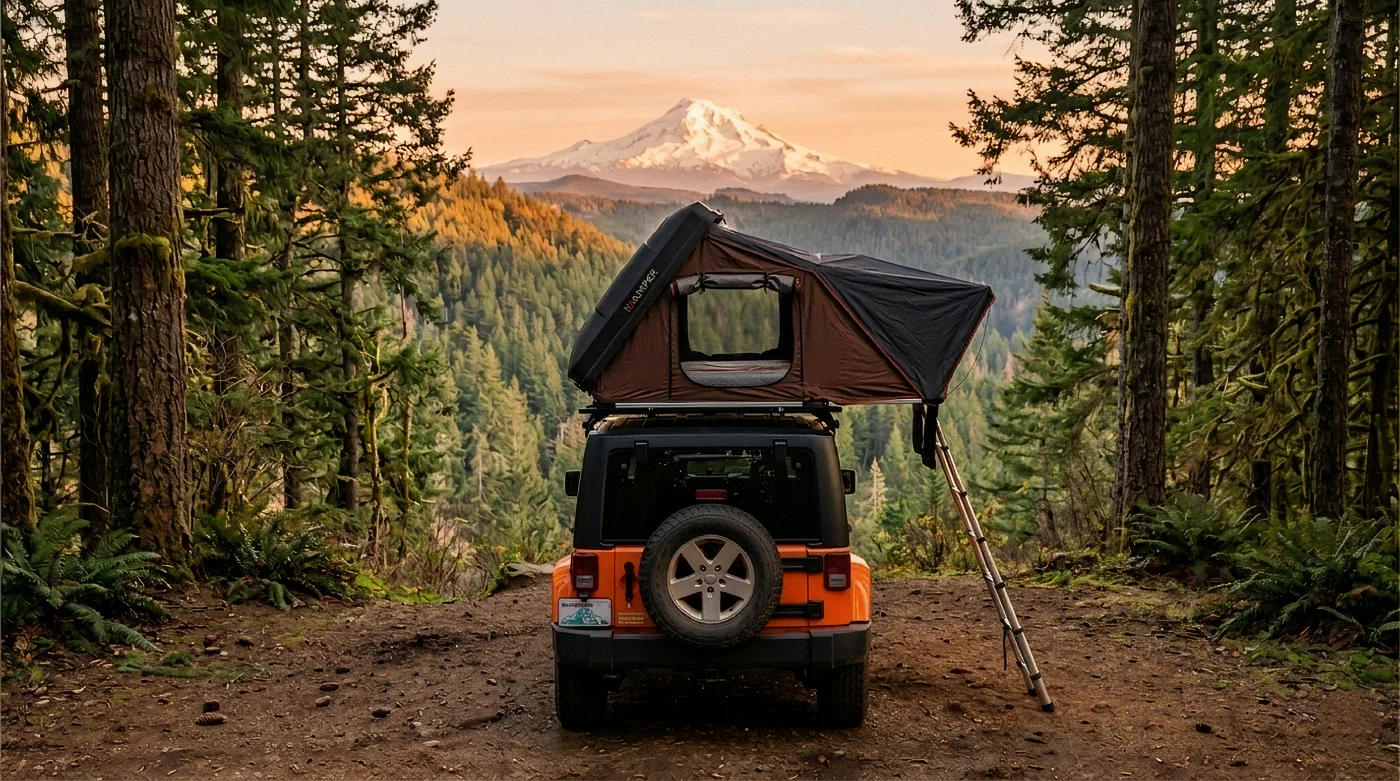
Overlanding is vehicle-based travel off the pavement into remote places where the journey itself is part of the point. That’s the technical answer. The real draw — especially as a beginner — is that overlanding is how you unlock dispersed camping.
Dispersed camping means pulling off a forest road onto public land — national forest (NF), Bureau of Land Management (BLM), Department of Natural Resources (DNR), or Bureau of Reclamation (BOR) — and setting up camp. No reservation. No fee. No neighbor’s generator. Just a clearing you found, and the next sunrise is yours.
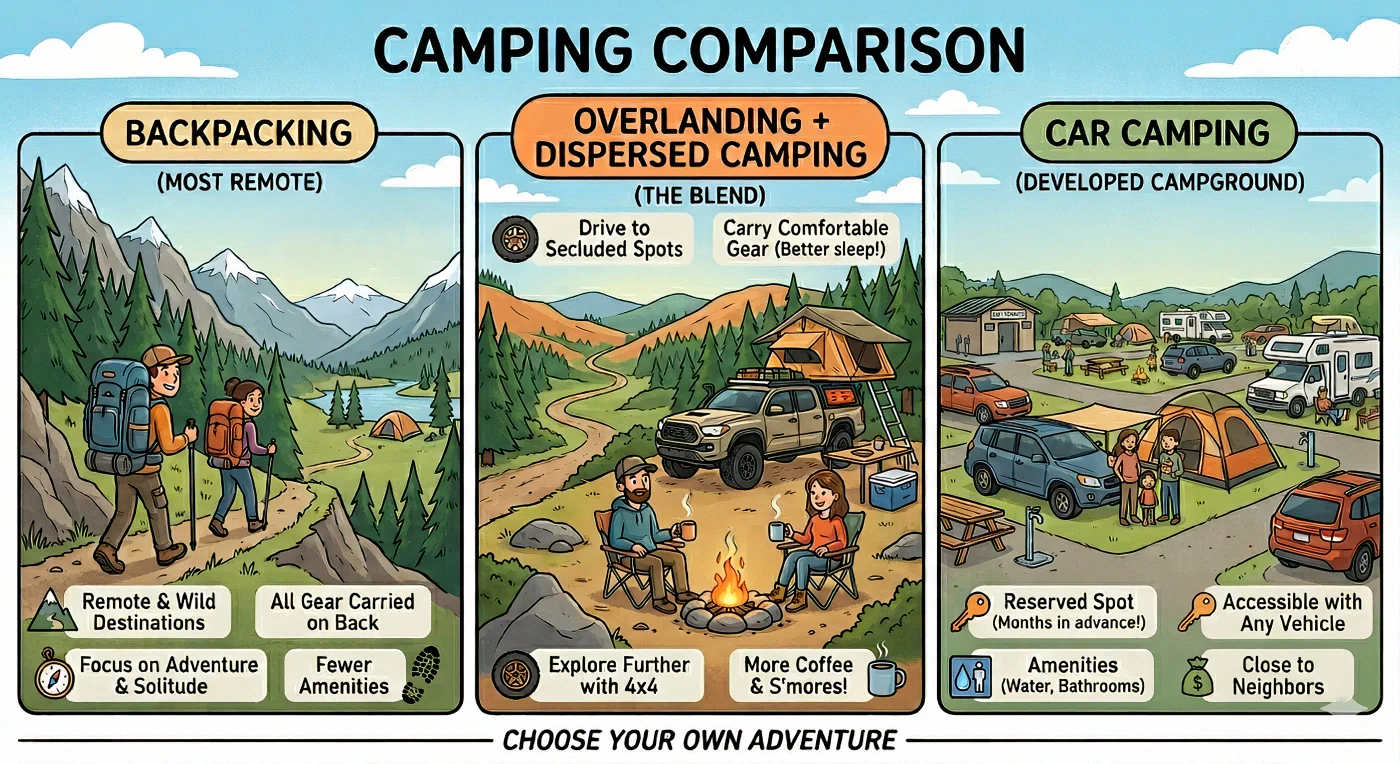
The contrast with what you might already know:
- Car camping at a developed campground means reserving months in advance, paying $40 a night, and parking 15 feet from someone else’s RV.
- Backpacking gets you remote — on foot, with everything on your back, and a lot less coffee and s’mores.
- Overlanding + dispersed camping is the in-between. You drive to remote, carry comfortable gear, and sleep somewhere most people will never see.
Washington alone has over 9 million acres of public land where dispersed camping is legal. The hard part isn’t getting permission. It’s knowing where to look — which we’ll get to.
Why the PNW Is the Playground
A few reasons Washington is one of the best states in the country for your first overlanding trip:
- It’s close. The I-90 corridor, the Mountain Loop Highway, Gifford Pinchot National Forest — all within 90 minutes of Seattle.
- The roads are forgiving. Most beginner-friendly routes are well-graded gravel or mild dirt two-track. You don’t need to ford a creek your first weekend.
- The scenery does the heavy lifting. Old-growth forest, volcanic peaks, rivers that look filtered. The PNW makes everyone look like a better photographer than they are.
- The season is real but workable. Most routes open late May through October. June through September is the sweet spot. Winter? Our rigs run heated blankets and snow tires for chasing powder days.
The Three Things That Stop Most People
Here’s why most overlanding-curious people never actually go — and how Rad Rigs solves each one.
1. The vehicle
A capable 4x4, a rooftop tent, a camp kitchen, water storage, a power system… — built out, that’s $15,000+ in gear before you’ve turned a tire. Most people aren’t investing all of that on a hypothesis the overlanding life is for them.
Our move: we rent fully kitted-out rigs for beginners. Rooftop tent with bedding, pull-out camp kitchen with propane stove, onboard water, camp chairs and table, power station, basic recovery gear, and a few surprises in the glovebox. You show up, we hand you the keys, Trip Guide in the glovebox. Done.
2. The research
Finding a good dispersed campsite means figuring out which land is BLM vs. U.S. Forest Service (USFS) vs. DNR vs. BOR, reading Motor Vehicle Use Maps (MVUMs), cross-referencing community apps, and calling ranger districts to confirm roads are open. It’s not hard once you’ve done it twice — it’s intimidating before you’ve done it once.
Our move: every rental comes with a Trip Guide — curated beginner-friendly routes we’ve personally scouted. GPS coordinates, road condition notes, seasonal access, and the things-to-know we wish someone had told us. You don’t have to become a forest road expert this weekend. You can just go.
3. The bathroom
There’s no toilet out there. There’s no dumpster. Everything you pack in, you pack out — including waste. This is the part nobody talks about, and the part that genuinely scares people.
Our answer: it’s easier than you think. Dig a 6-inch hole 200 feet from water sources (we include the trowel, TP, and even a squatty potty), do your business, fill it in. Trash rides home with you. Every Rad Rigs rig is packed with the gear you need plus extra trash bags — for what you brought, and for whatever the last person left behind. After your first time, it’s easy-peasy.
What the First Night Feels Like
You drive out of the city, the pavement ends, and somewhere around mile four on a forest road your phone loses signal. By the time camp is set up and dinner’s going on the open flame, you’ve stopped checking it — not because you forced a digital detox, but because there’s simply nothing to check. The sunset by the creek is a better view anyway.
The second morning is when most people get it. Hot coffee on a camp stove. Mist in the trees. Absolutely nowhere to be. Someone in the group inevitably says “we should do this more.” Everyone agrees.
It’s not that camping is a magic cure-all. It’s just that putting yourself somewhere genuinely remote, even for 48 hours, restores your sense of scale. There’s something quietly empowering about real self-sufficiency in a world that increasingly does it all for us. Break the routine. Try a night on public lands.
How TREAD Lightly! Keeps This Whole Thing Possible
Here’s the catch: dispersed camping stays free, open, and unregulated specifically because the people who use it take care of it. The Forest Service closes sites that get trashed. Once a road is gated, it almost never reopens.
So if you want overlanding to still exist when your kids are old enough to come — TREAD Lightly! is the playbook. It’s the stewardship framework built for motorized recreation, the off-road equivalent of Leave No Trace (which is for foot travel).
Five principles, short version:
- Travel on designated roads only. Don’t widen a trail by driving around a puddle.
- Respect other campers, hikers, landowners, and wildlife. Yield uphill. Keep noise down.
- Educate yourself on rules and current conditions before you go.
- Avoid sensitive areas: meadows, wetlands, lakeshores, soft ground.
- Do your part. Pack out what you brought, and what others left. Leave it better.
Treading lightly isn’t a noble sacrifice. It’s how the good spots stay good and available for the next generation.
Ready to Try It?
If you want to dig deeper first — how to find free campsites in Washington, beginner-friendly routes, full rig tours.
Or, if you’re the type who learns by doing:
Check rig availability and book your dates →
The forest roads will still be there if you want to read more first. But they’re better in person.